
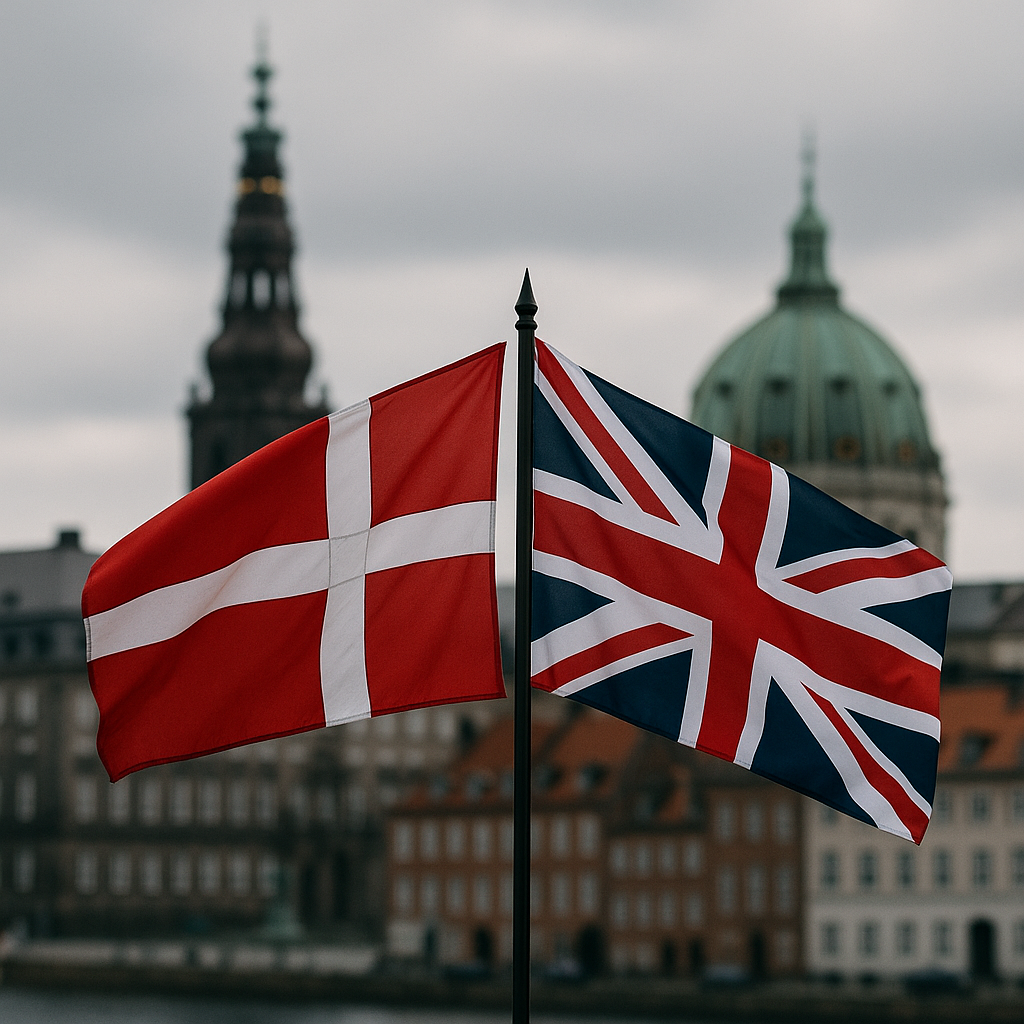
THE DANISH BLUEPRINT: IS THIS A MODEL OR A MISTAKE FOR BRITAIN?
When Policy Meets People: What the Danish Framework Could Mean for Families, Communities, and the Church’s Witness
Every policy and every decision carry consequences that shape the lives of millions. As Britain stands at a crossroad, it is imperative to ask a difficult question: does the nation act in the interest of its people, or in the interest of profit?
The government has signalled for the adoption of Denmark’s immigration framework. This being one of the strictest models in Europe. The direction has already stirred concern, debate and social panic across the country, especially among those who fear that these changes may redefine their prospects.
Denmark’s immigration system is built on high thresholds and stringent conditions. It requires high income levels before families can be reunited together, an extensive integration test before residency can be granted, and ongoing assessments that measure language, employments and cultural participation. In Denmark, this model is seen to uphold national cohesion. However, critics would argue that these structures create barriers that dent lower – income households and restrict those most in need of safety and stability.
Will Britain replicate this same model?
Reports have shown that several parts of the Danish immigration model are being studied by Britain, including its high income requirements for family reunification and its rule that couples ought to prove a stronger “connection” to the country before being allowed to fully settle. For many people living in Britain, especially our young adults, students, low-income workers and immigrant families; this matter has created real fear. The worry comes from, not knowing if they will meet future thresholds, and that Britain could become far harder to live and settle in unless they meet very strict financial and cultural criteria.
Academics have strictly warned that applying Denmark’s model to Britain would widen social inequality and create a society of instability rather than cohesion.
And so, the question becomes: How must the Church respond?
For the Church, this conversation must not be influenced by political preference, party loyalty or demographic statistics. It is fundamentally about God’s people and God’s people only. It is about the families that may be divided by income thresholds. It is about the young adults who may no longer qualify to bring loved ones into the country they call home. It is about those that contribute daily to the NHS, education, transport, and other essential services; yet may be left vulnerable under this new regime.
Scripture consistently reminds us of God’s heart for the foreigner, the traveller and the stranger. The bible would highlight:
“Do not forget to entertain strangers, for by so doing some have entertained angels” (Hebrews 13:2 NKJV)
“The Lord watches over the strangers”(Psalms 146:9 NKJV)
This matter demands compassion. It calls believers into a place of advocacy, prayer, and understanding. The Church is positioned in a place where we can provide support for those currently experiencing uncertainty. To stand for dignity and justice where fear and division begin to self-exalt. If the Church does not speak for the vulnerable, then who will?
Britain must now decide whether the Danish blueprint is a model to follow or a severe mistake that could fracture the nation. Policies are drafted in Parliament, but the consequences of these decisions are lived out in real homes, real families, and real communities. In times like this, the responsibility of the nation and of the Church is to ensure that even through political strategies, humanity is never forgotten.
Other Articles

The most prolific criminal case of the year has finally come to an end as P. Diddy...

On June 27th Congo and Rwanda signed a peace deal that aimed to end decades of conflict...

The marketplace today is often viewed as a place lacking integrity and purpose...
From the overflow of Upper Room 2025, all roads led to Kingdom Ambassadors Centre...

Delite Hair Care provides all essentials for a complete hair care routine, for all ages...

It is a very well-known verse; David’s contemplation of how God wove him in his mother’s...